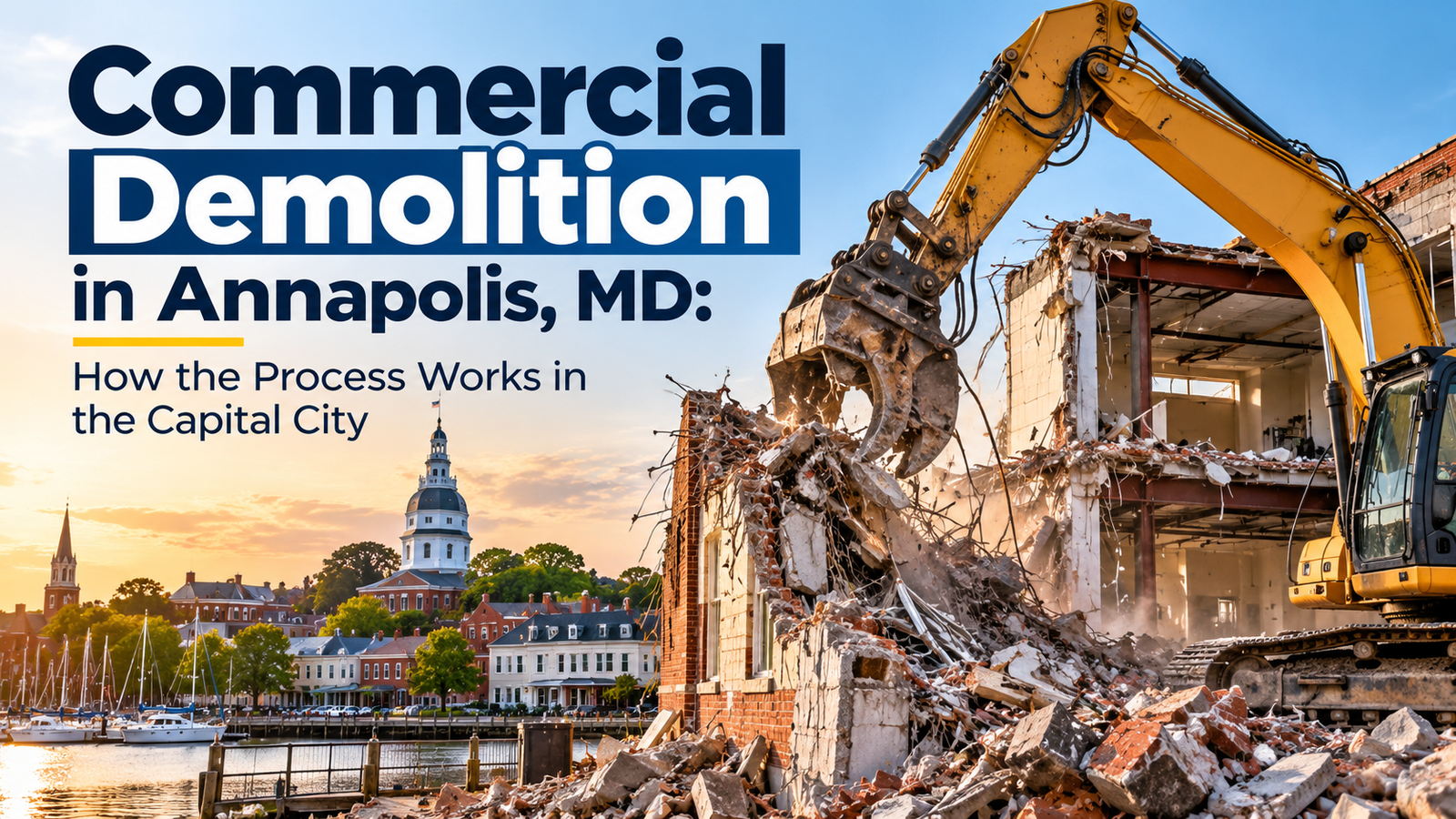
Annapolis is Maryland’s state capital and one of the most historically significant cities on the East Coast. Its waterfront position on the Severn River, its dense colonial-era downtown, and its role as a major commercial and governmental hub create a distinctive context for commercial demolition Annapolis one that involves more regulatory layers, more environmental sensitivity, and more historic preservation complexity than most Maryland cities its size. Commercial demolition in Annapolis requires understanding how those layers interact before any project begins.
What Commercial Demolition Covers in Annapolis
Commercial demolition in Annapolis encompasses the planned removal of structures used for retail, office, hospitality, institutional, industrial, and mixed-use purposes. The city’s commercial landscape includes waterfront properties, historic district buildings, post-war commercial strips along US-50 and Rte 2, marina and boatyard infrastructure, naval support facilities adjacent to the Naval Academy, and the newer commercial development in the Parole and Bestgate areas west of the city.
The nature of a commercial demolition project in Annapolis is heavily shaped by the building’s age and location. A pre-1920 commercial building in the historic district carries a very different regulatory burden than a 1970s concrete block strip center on Generals Highway. Understanding which regulatory framework applies and at what point in the process is the first step in planning any commercial demolition.
Maryland and Anne Arundel County Regulatory Framework
Commercial demolition in Annapolis sits within a regulatory framework involving federal, state, county, and city authorities. At the federal level, the EPA’s National Emission Standards for Hazardous Air Pollutants (NESHAP) govern asbestos handling in all commercial demolition. Any commercial structure built before 1980 and in Annapolis, a significant proportion of commercial buildings predate 1980, many predate 1940 must undergo a thorough asbestos inspection by a licensed inspector before demolition. When regulated asbestos-containing material (RACM) is found, Maryland Department of the Environment (MDE) must be notified at least 10 working days before demolition begins.
Anne Arundel County’s Office of Inspections and Permits issues demolition permits for commercial structures in Annapolis. Permit applications require submittal of site plans, utility disconnection documentation, and for structures of historical significance, a determination from the City of Annapolis Historic Preservation Commission or the Maryland Historical Trust before the county permit can be finalized.
The City of Annapolis administers its own Historic District regulations under the Annapolis Code, Chapter 21.56. The Historic Preservation Commission (HPC) reviews applications for demolition of structures in the Historic District and the Heritage District. Contributing structures those that are part of the historic fabric of Annapolis face the most rigorous review. The HPC can require documentation, impose a demolition delay, or in exceptional cases involving particularly significant structures, recommend denial.
Maryland’s Chesapeake Bay Critical Area law is especially relevant in Annapolis because of the city’s waterfront character. The Critical Area defined as land within 1,000 feet of tidal water and tidal wetlands covers a substantial portion of Annapolis’s commercial core and waterfront properties. Demolition and subsequent redevelopment within the Critical Area requires compliance with the Critical Area Commission’s development standards, including buffer requirements, impervious surface limits, and stormwater management provisions.
Historic Preservation Review in Annapolis’s Commercial Districts
Annapolis has one of the most extensively regulated historic districts in Maryland. The Historic District encompasses the original colonial town and extends into surrounding areas. The Heritage District provides a secondary layer of protection for adjacent historic fabric. Together, these designations cover much of the city’s older commercial inventory the buildings along Main Street, West Street, Dock Street, and the surrounding blocks that form the heart of the city’s commercial life.
For commercial demolition projects within these districts, the HPC review process begins with a pre-application conference, which allows the applicant to understand the Commission’s concerns before formal submission. The formal application requires documentation of the existing structure photographs, measured drawings, and historical research establishing the building’s significance and integrity. For contributing structures, the burden of demonstrating that demolition is warranted falls on the applicant.
Annapolis’s Historic District is listed on the National Register of Historic Places and is also a National Historic Landmark District the highest designation available for historic areas. This status means that federally permitted or federally funded projects affecting the district require Section 106 review under the National Historic Preservation Act, which can involve the Advisory Council on Historic Preservation and adds another consultation layer to complex projects.
Alternatives to demolition rehabilitation, adaptive reuse, relocation of the structure are given serious consideration in the Annapolis HPC process. Many buildings that might seem to be candidates for demolition because of their condition have been successfully rehabilitated in Annapolis’s active historic property market. The Maryland Historic Revitalization Tax Credit, which provides state tax credits for certified rehabilitation of historic structures, has supported numerous commercial building renovations in the city.
Environmental Conditions Common to Annapolis Commercial Sites
Annapolis’s history as a waterfront commercial and maritime center means that many commercial sites carry environmental legacy conditions that must be assessed before demolition. Former marine-related businesses boat repair, fuel storage, shipbuilding may have petroleum contamination from fueling operations and boatyard chemicals. Marina-adjacent properties frequently have elevated metals in the sediments and soils from antifouling paints, which historically contained tributyltin and copper compounds.
Underground storage tanks (USTs) are common beneath older Annapolis commercial properties, particularly former service stations, fueling facilities, and properties with historic heating oil systems. MDE’s UST program requires proper tank closure procedures removal, cleaning, and documentation before demolition. Properties with documented petroleum releases may require site assessment and remediation concurrent with or prior to demolition.
Lead paint is present in virtually every commercial structure in Annapolis built before 1978. Demolition of these structures generates lead-contaminated debris that must be managed under Maryland’s lead regulations. Asbestos, as noted, is present in pre-1980 buildings and requires survey and, if RACM is found, abatement before mechanical demolition. PCBs may be present in electrical equipment, older caulks, and some roofing and floor tile materials in pre-1980 buildings.
Demolition Methods for Annapolis’s Commercial Building Stock
The compact nature of Annapolis’s commercial district creates significant constraints on demolition method selection. Many commercial buildings in the historic core are party-wall structures sharing a wall with an adjacent occupied building. Demolition of a party-wall structure requires specialized sequencing that protects the shared wall and the adjacent building throughout the demolition process. High-reach excavators with precision attachments allow controlled disassembly that protects adjacent structures.
Selective deconstruction systematic disassembly to recover reusable materials is particularly valuable in Annapolis’s historic district, where architectural salvage from significant buildings has both historic value and market demand. Brick from colonial and federal-era commercial buildings, heart pine flooring, period hardware, and decorative architectural elements can be recovered through selective deconstruction before mechanical demolition proceeds.
For isolated commercial structures away from the historic core the post-war commercial strips along Generals Highway, Defense Highway, and Rte 2 conventional mechanical demolition using excavators is the standard approach. These structures, built of concrete block, steel frame, and similar materials, are demolished efficiently with standard demolition equipment.
Post-Demolition Site Conditions and Chesapeake Bay Considerations
After commercial demolition in Annapolis, site stabilization and stormwater management are critical because of the city’s proximity to the Severn River, Spa Creek, and their tributaries all of which drain directly to the Chesapeake Bay. Maryland’s Phase II MS4 stormwater regulations and the City of Annapolis’s stormwater management requirements mandate that disturbed areas be stabilized promptly and that construction activity not discharge sediment to waterways.
The Annapolis area’s soils predominantly clay-bearing sediments overlying the Coastal Plain geology of the Western Shore have relatively low permeability, meaning that stormwater runoff from disturbed sites moves quickly across the surface rather than infiltrating. Silt fencing, inlet protection, and sediment traps must be in place before demolition begins and maintained throughout site work.
Properties in the Chesapeake Bay Critical Area face specific post-demolition requirements related to impervious surface. Redevelopment within the Critical Area must not increase impervious surface coverage beyond what existed before, or must provide equivalent mitigation through on-site stormwater management. This constraint affects the planning for new development on demolished commercial sites near the waterfront.
Frequently Asked Questions: Commercial Demolition in Annapolis
Does demolishing a building in Annapolis’s Historic District require city approval?
Yes. Demolition of structures within the Annapolis Historic District or Heritage District requires review and approval by the City of Annapolis Historic Preservation Commission before any other permits can be finalized. The process begins with documentation of the structure and a determination of its contributing status. Contributing structures receive the most rigorous review; non-contributing structures still require HPC notification and may face conditions on documentation before demolition.
What is the Chesapeake Bay Critical Area and how does it affect commercial demolition?
The Critical Area is land within 1,000 feet of tidal water and tidal wetlands, subject to the Maryland Critical Area Act’s development standards. Much of waterfront Annapolis falls within the Critical Area. Demolition and subsequent redevelopment in this zone requires compliance with Critical Area Commission standards, including buffer requirements, impervious surface limits, and stormwater management. The Critical Area designation adds regulatory review to projects near Annapolis’s waterfront.
Are asbestos surveys required for all commercial demolition in Annapolis?
Federal NESHAP regulations require a thorough asbestos inspection by a licensed inspector before demolition of any commercial structure, regardless of age. The probability of finding regulated asbestos-containing material is higher in pre-1980 buildings and most of Annapolis’s historic commercial buildings predate 1980 but the inspection requirement applies universally. If RACM is found, MDE notification and proper abatement before mechanical demolition are mandatory.
How are party-wall buildings demolished safely in Annapolis’s dense downtown?
Party-wall demolition requires engineering analysis of the shared wall and adjacent structure before work begins. Demolition sequencing protects the party wall throughout the process, typically by working from the top down and supporting the shared wall as each floor is removed. Vibration monitoring of adjacent structures during demolition is standard practice. High-reach excavators with precision demolition attachments provide controlled disassembly that protects what must remain standing.